What a Care Label Can Tell You Before the First Wash
Learn how to read a garment care label, decode its symbols, and choose a first wash based on the instructions—not assumptions about the fabric.
Before you put a new shirt in the washer, check its care label: the small symbols and words can tell you how to clean, dry, and press that specific garment. Reading the label carefully helps you distinguish stated instructions from guesses based on a fabric name, color, or familiar-looking design.
A care label is guidance for the finished item, not a general rulebook for every garment made from the same material. Construction, linings, trims, dyes, and finishes can all affect the instructions. If a symbol is unfamiliar or the wording seems contradictory, pause and resolve that uncertainty before choosing a wash setting.
Why do care instructions seem to contradict the fabric name?
A label might identify a garment as cotton, polyester, wool, or a blend, but that description does not tell you the whole care story. Two cotton garments may have different dyes, surface treatments, stitching, or attached details. A lined jacket can require different handling from a plain cotton tee, even if both contain cotton.
Use the fiber information to understand what the garment is made of; use the care instructions to decide what the maker advises for the item as sold. Avoid replacing a specific instruction with a broad assumption such as “cotton can take hot water” or “synthetics should always be washed cold.” The label’s wording is the more relevant starting point.
Look for more than one care label if the garment has separate components. A removable lining, detachable hood, or attached accessory may have its own tag. Follow the directions that apply to each part, and check how pieces should be separated or reattached before cleaning.
What if the symbols are unfamiliar?
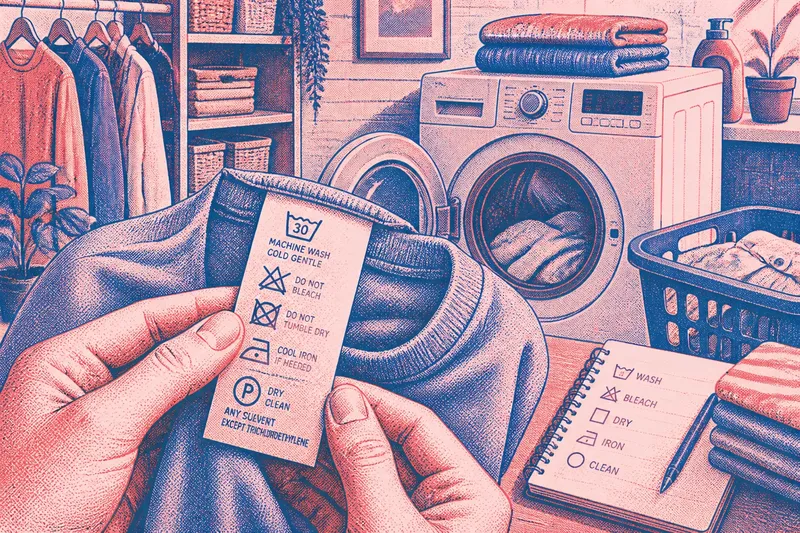
Care symbols are a compact visual language. A tub generally relates to washing, a triangle to bleaching, a square to drying, an iron to ironing, and a circle to professional cleaning. Marks added to the basic symbol change the instruction: a cross usually means do not use that process, while dots or lines can indicate limits or gentler treatment.
Read each mark as part of its full symbol rather than guessing from its shape alone. A line beneath a wash tub, for instance, is not decoration; it signals a different handling instruction from the same tub without a line. The number or other mark inside a symbol also matters, so avoid choosing a setting based only on the icon’s outline.
If you cannot identify a symbol, compare the complete label with a care-symbol guide from a reputable garment-care organization or appliance manufacturer. Match the details exactly, including crossed-out marks and underlines. Do not assume that a familiar-looking icon means the same thing when its extra marks differ.
Why is the label missing, faded, or hard to read?
Some tags are sewn into a seam, printed on fabric, or placed where they are easy to overlook. Check the side seams, inside the waistband, and near the neck or hem without pulling hard on a tag that is stitched into a delicate seam. A removable hangtag may list fiber content, but it is not a substitute for permanent care instructions.
For a faded label, use a phone camera to enlarge the visible print or adjust the light, then compare the parts you can read with a symbol guide. Do not fill in missing words from memory. If only part of an instruction is legible, contact the retailer or garment maker with the product name or style information, if available.
When no reliable care instruction can be recovered, choose a conservative option only if it suits the garment’s visible construction, and recognize that uncertainty remains. For an item with structured panels, delicate embellishment, or a special finish, ask a professional cleaner rather than treating a guessed setting as the manufacturer’s advice.
How should you handle conflicting instructions?
First, determine whether the apparent conflict is between different parts of the label or between the label and an assumption. “Machine wash” and “do not tumble dry,” for example, can both be valid: one describes washing, the other drying. Follow each instruction at the stage it covers rather than treating the label as one single setting.
Next, check whether the label gives a general instruction plus a specific exception. Wording such as “wash with like colors” adds a sorting condition; it does not replace the stated wash method. Likewise, a note about turning a garment inside out may accompany, rather than modify, its main cleaning direction.
If two instructions truly conflict, such as one part indicating machine washing while another says dry clean only, do not select whichever seems more convenient. Check whether the directions refer to separate components, then consult the maker or a qualified garment-care professional if the conflict remains. Product labels, manufacturer instructions, and local rules may determine the appropriate option.
What care-label questions come up before a first wash?
Does “dry clean” mean the garment cannot get wet?
It tells you to use professional cleaning rather than assuming an ordinary home wash is suitable. It does not, by itself, explain why that method is specified, so avoid inferring that the fabric alone is the reason.
Can you wash a garment in cold water if the label allows a warmer setting?
A cooler wash may be a choice some people make, but it is not automatically equivalent to the stated instructions for every garment or soil. Follow the label’s complete wording and consider the cleaning task rather than treating a lower setting as universally safer.
What does a crossed-out triangle mean?
It indicates that bleaching should not be used. Do not infer that a non-chlorine bleach is permitted unless the label separately states that it is.
Should you remove the label before washing?
Keep care information accessible, especially before the first wash. If a tag is irritating, record its wording and symbols clearly before removing it, and make sure the remaining garment tag does not contain additional instructions.
What should you do when the label gives several instructions?
Read from cleaning through drying and pressing, not just the first symbol. A garment may be washable but unsuitable for a dryer, or safe to press only with a particular restriction. Note every instruction that applies before loading the washer so you do not solve one problem while creating another.
- Find every care label, including tags on detachable pieces.
- Read the written instructions alongside the symbols.
- Identify any crossed-out marks, dots, or lines that change a symbol’s meaning.
- Separate wash, bleach, drying, ironing, and professional-cleaning directions.
- Look for instructions about color sorting, turning the item inside out, or closing fasteners.
- Resolve any missing or conflicting direction before choosing a process.
Imagine you have a new dark blouse with a printed care label that says machine wash, while its small symbols show a crossed-out triangle and a crossed-out square. The expected reading is that washing is allowed, bleaching is not, and tumble drying is not; you would still check the label for the permitted wash conditions and any further drying direction rather than guessing from “dark blouse.”
How can you tell instruction from assumption?
Keep three kinds of information separate: the care directions, the fiber description, and your own observations. “Machine wash” is an instruction. “Polyester” describes material. “This feels sturdy” is an impression. Only the first directly tells you what the label advises, while the other details can help you ask better questions without overruling it.
That distinction matters most when an item looks ordinary but contains a feature that changes how it should be handled. A smooth lining, glued decoration, or crisp finish may not be obvious from the outside. The care label reflects the garment as a whole, so its instructions can be more cautious than a guess based on one visible fabric.
For the first wash, treat the care label as the clearest available description of the maker’s intended handling. Read every symbol in context, keep separate instructions attached to the right garment parts, and seek clarification when the label cannot be read or reconciled. That small pause gives you a more informed decision than relying on the fabric name alone.